(772) 297-0543

Florida ADA requirements for commercial sliding glass doors

Same-Day Service
Free Estimates
All Major Brands
Residential & Commercial
Licensed & Insured
TL;DR

Commercial sliding glass doors in Florida must meet both federal ADA standards and Florida Building Code requirements, including 32-inch clear width, maximum 5-pound opening force, and specific threshold heights. In South Florida, impact-rated glass and corrosion-resistant hardware add complexity to compliance installations.

Sliding door repair in Fort Pierce FL

Florida ADA requirements for commercial sliding glass doors combine federal accessibility standards with state-specific building codes that address hurricane protection and climate challenges. Your commercial property in Port St. Lucie must comply with the 2010 ADA Standards for Accessible Design plus Florida Building Code Chapter 11. Both sets of regulations work together to ensure safe, accessible entry for all customers and employees.

South Florida's coastal environment creates unique compliance challenges. Salt air accelerates hardware corrosion, while impact glass panels weighing 150-300 pounds require specialized track systems that maintain ADA opening force limits.

Key ADA Width and Clearance Requirements

All accessible commercial entrances must provide a minimum 32-inch clear opening width when the door is open 90 degrees. This measurement excludes the door thickness and any protruding hardware. Most commercial sliding doors need to be at least 36 inches wide to achieve this clear space.

Maneuvering clearance on both sides of the door varies based on approach direction. Front approaches require 60 inches of depth, while latch-side approaches need 54 inches on the pull side and 42 inches on the push side.

Threshold Height Limitations

Thresholds at sliding door entrances cannot exceed 1/2 inch in height for accessible routes. Beveled thresholds between 1/4 and 1/2 inch must have a slope no greater than 1:2. This requirement often conflicts with water infiltration prevention, especially during heavy Florida storms.

Door Opening Force Standards

Interior sliding doors require a maximum opening force of 5 pounds. Exterior doors face wind load challenges but cannot exceed this limit unless equipped with power-assisted mechanisms. Heavy impact glass commonly used in St. Lucie County buildings since 2002 often requires automatic operators to meet this standard.

Florida Building Code Additions to ADA Standards

The Florida Building Code adopts ADA requirements but adds mandatory hurricane protection standards for commercial properties in high-velocity hurricane zones. All commercial sliding doors installed after 2002 must use impact-rated glass or acceptable protection systems. Popular brands like PGT, CGI, and Andersen offer ADA-compliant impact door systems.

Corrosion resistance is another Florida-specific concern addressed in the code. Hardware exposed to coastal conditions in Fort Pierce and Port St. Lucie must meet grade 316 stainless steel standards or equivalent. Standard aluminum tracks and rollers degrade quickly in salt air, causing doors to bind and exceed ADA force limits.
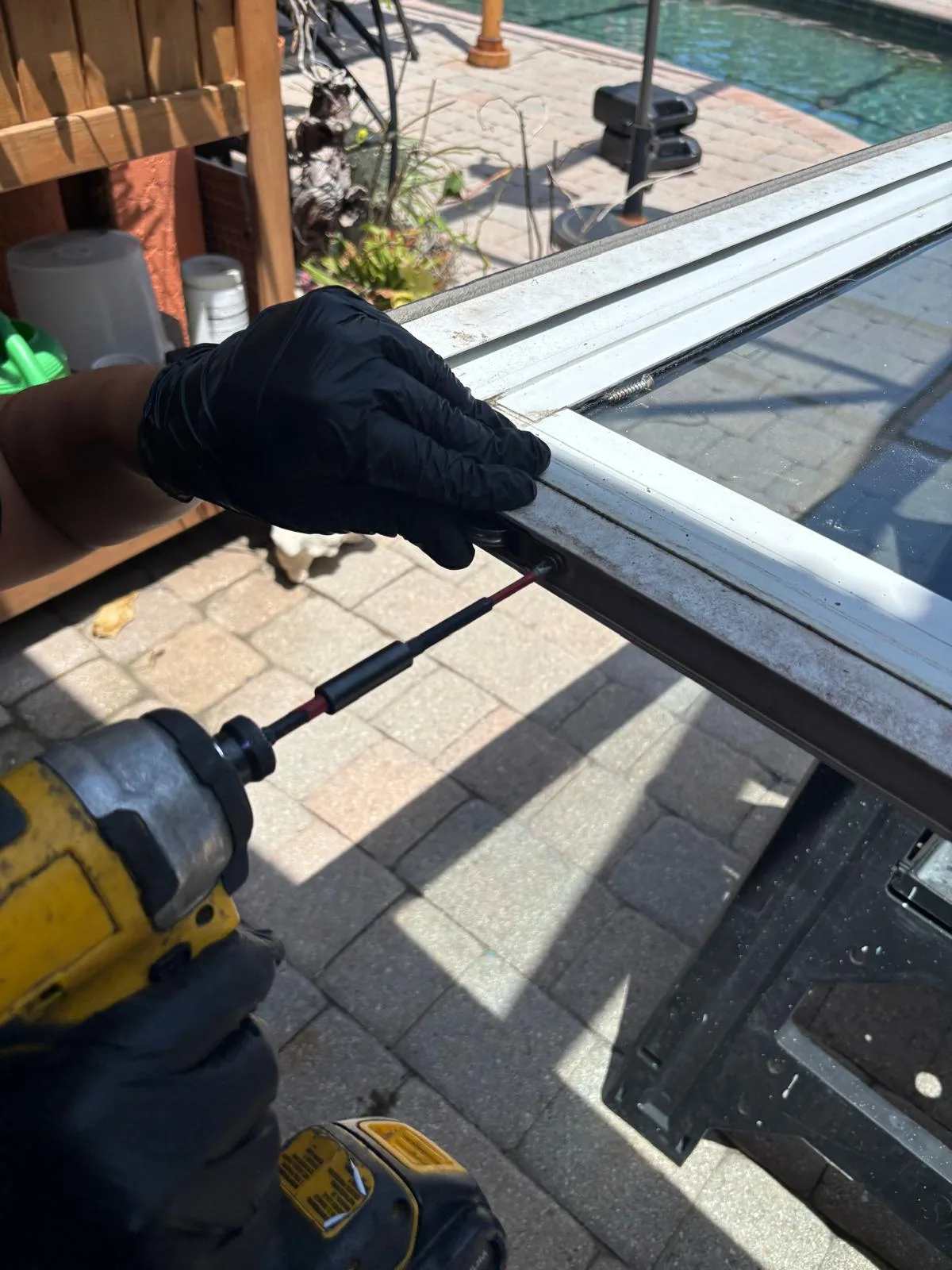
Sliding door components being serviced in South Florida

Automatic Door Operator Requirements for ADA Compliance

Power-assisted operators solve multiple compliance challenges for heavy commercial sliding doors. They ensure consistent opening force below 5 pounds regardless of door weight or wind conditions. Opening speed must allow safe passage between 3-5 seconds from full open to full close.

Activation controls must be located 15-48 inches above the floor and within 5 feet of the door opening. Push plates require maximum 5-pound activation force. Motion sensors provide the most accessible option but need proper adjustment to avoid nuisance activations in high-traffic areas.

Backup Power and Emergency Egress

Florida Building Code requires backup battery systems for automatic doors on accessible routes. During power failures, doors must either fail to a safe open position or operate on battery backup for minimum 90 minutes. Many businesses in South Florida learned this lesson during extended hurricane outages.

Common Compliance Failures in Existing Commercial Properties

Track misalignment represents the most frequent ADA violation in older Port St. Lucie commercial buildings. Settling foundations and humidity-induced frame warping cause doors to drag, increasing opening force beyond legal limits. What starts as a minor maintenance issue becomes a civil rights violation.

Worn rollers create similar problems. A full set of commercial-grade rollers costs $199-$299 per panel, while track realignment runs $99-$199. Delaying these repairs risks expensive accessibility complaints and potential lawsuits from customers or employees.

Professional ADA Compliance Inspections in Port St. Lucie

Marco Delgado at Port St. Lucie Sliding Door Repair has evaluated commercial door compliance throughout St. Lucie County since 2018. He measures opening force, verifies clearances, and identifies corrections needed to meet both ADA and Florida Building Code standards. Commercial properties deserve accurate assessments from someone who understands local conditions.

Schedule a compliance inspection by calling (772) 297-0543 for a custom quote based on your specific door configuration. For commercial properties in Martin County, contact our partner at treasurecoastslidingdoorrepair.com for the same quality service.

Frequently Asked Questions

Do all commercial sliding doors in Florida need to be automatic to meet ADA requirements?
No, manual sliding doors can meet ADA standards if they maintain maximum 5-pound opening force and proper clearances. However, doors with heavy impact glass (150-300 pounds) common in South Florida typically require automatic operators to stay below the force limit. Wind load and salt air corrosion make manual compliance difficult to maintain long-term in coastal locations.
What happens if my commercial door fails an ADA compliance inspection?
You receive a written notice detailing specific violations and a deadline for corrections, typically 30-60 days depending on severity. Failure to remedy violations can result in fines, lawsuits from individuals, or Department of Justice enforcement actions. Most corrections like track alignment ($99-$199) or roller replacement ($199-$299 per panel) cost far less than legal penalties.
Are impact glass doors harder to keep ADA compliant in Florida?
Yes, the additional weight of impact-rated glass creates ongoing maintenance challenges. Panels weighing 150-300 pounds place greater stress on rollers and tracks, causing faster wear. Salt air in Port St. Lucie and Fort Pierce accelerates corrosion of adjustment mechanisms. Regular maintenance every 6-12 months helps maintain compliant opening force with heavy impact doors.
Can I make my existing commercial door ADA compliant or do I need replacement?
Most existing doors can be modified for compliance through hardware upgrades, track realignment, or automatic operator installation. Common fixes include lowering thresholds, replacing worn rollers, adding power assists, and adjusting clearances. Complete replacement becomes necessary only when frame damage, glass size, or structural issues prevent modification to meet required 32-inch clear width.
How often should commercial sliding doors be inspected for ADA compliance?
Annual inspections catch problems before they become violations. High-traffic doors or those exposed to harsh coastal conditions benefit from twice-yearly checks. South Florida humidity and salt air cause hardware degradation that gradually increases opening force beyond the 5-pound limit. Regular maintenance visits ($89-$159) prevent expensive emergency repairs and compliance issues.
Do Florida ADA requirements differ between new construction and existing buildings?
New construction must meet full ADA and Florida Building Code compliance from day one. Existing buildings follow different standards under Title III requiring barrier removal when readily achievable. However, any alteration or door replacement triggers current code requirements for that element. Properties built before 2002 adding new sliding doors must include impact glass protection in applicable zones.
MD
Marco Delgado
Sliding Door Repair Technician. PSL Native. Solo since 2018.

Marco grew up in Port St. Lucie and learned the trade from his uncle Ray in Jensen Beach. He has been running his own repair operation since 2018, servicing St. Lucie County homes and HOA communities. For Martin County jobs, he refers customers to Treasure Coast Sliding Door Repair.

Need a Sliding Door Fixed in Port St. Lucie?

Marco services all of St. Lucie County. Same-day appointments available on most repairs. Call for a free estimate before scheduling.

(772) 297-0543